
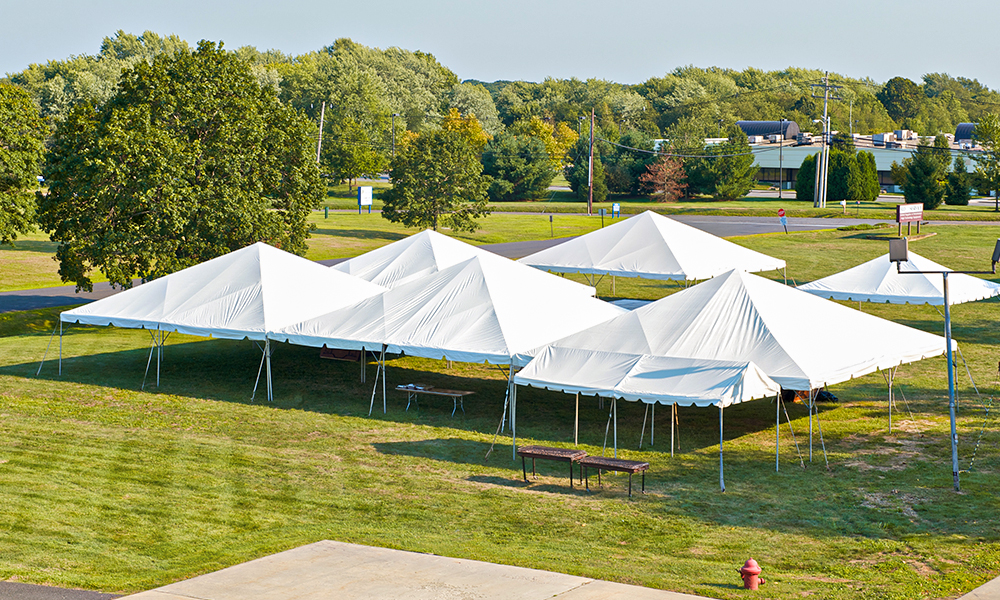
Drive through any Ugandan town on a weekend, and you will see them: white and coloured tents stretching across compounds, school fields and car parks.
They host weddings, musical concerts, send-offs, graduations, funerals and political rallies. In recent years, they have also become temporary offices, exhibition halls, classrooms and even field clinics.
The danger of these structures became clear recently at Mesach Ssemakula’s musical concert at Kingdom Kampala. Thousands of revellers flocked the concert that was interrupted by rains that blew up tents.
Since then, there has been conversation, especially on social media, about how the tents should have been better positioned and erected for the comfort of the revellers.
Mesach’s concert brings to light the discussion of a tent as a building that should be designed and installed professionally. A tent is quick to put up, cheaper than a hall and easy to move. But when hundreds of people gather under it, the tent is a building. The law and common sense both say it should be designed, installed and managed like one.
Is a tent a “building” in law?
The answer starts with section 1 of the Building Control Act cap 136. It defines a building broadly as any structure, whether of a temporary or permanent nature, and, irrespective of the materials used in its erection, erected or used for or in connection with the accommodation or convenience of human beings or animals.
The key words are “temporary” and “structure”. The Act does not limit its meaning to brick and concrete. A tent is therefore a structure, it has a frame, a covering, anchors and a defined floor area, and it is placed on land to shelter people.
It may stand for a day or a season, but the definition does not exclude temporary structures.
In practice, organisers should not assume a small family gazebo and a 1,000-seat tent are treated alike. The larger and longer-standing the tent, the stronger the case for approval and professional design.
Design before decoration
A good tent begins with a few questions. How many people will it hold? What will they do inside: sit, dine, dance, pray or exhibit? How long will it stay up? How strong are the winds and rain at the site? Designers must consider:
Wind and rain loads. The frame, fabric and anchors must withstand gusts and the weight of water that collects on the roof. Uganda’s storms can arrive within minutes.
Capacity. Overcrowding is a leading danger. A tent should have a stated maximum number of people, based on floor area and available exits.
Site and ground. The ground should be level, firm and well drained. Soft or flooded ground will not hold stakes.
Services. Lighting, sound systems, cooking areas, toilets and standby power must be planned from the start.
Installation: where most accidents begin
Poor anchoring is a common weak point. Stakes must be driven to the right depth and pattern, and on paved or hard ground, ballast such as concrete blocks must be used. Guy ropes should be marked and kept out of walkways.
Installers should follow the manufacturer’s instructions and work under a trained supervisor. Poles, joints and connectors should be checked for bends, cracks and rust, and fabric should be free of tears and fitted tightly so wind cannot catch loose panels.
Where a structure is large, has a stage, or carries hanging lights, speakers or screens, a qualified engineer should approve the design and inspect the finished work.
Fire, exits and lightning
A tent can burn very quickly. Fabric should be flame-retardant, with a supplier’s certificate. Cooking, generators and cigarettes should be kept away from walls and roofs, and cooking should be done outside the tent.
Cables must be properly rated, insulated and raised off wet ground, and generators must stand outside, with a person assigned to watch them. Extinguishers should be near exits and generators.
Exits should be clearly marked, wide enough for the crowd, kept free of chairs and decorations, and placed on more than one side. Emergency lighting and a first-aid kit help if something goes wrong.
Uganda has a high rate of lightning strikes, and metal-framed tents attract danger. Organisers should monitor the weather and be ready to clear the tent when storms approach. After heavy rain, the roof must be checked for pools of water, which can pull a canopy down.
Dismantling and maintenance
The job does not end when the party does. Dismantling should be done in the reverse order of erection, by trained crews, and never in strong wind. Fabric should be dried before storage, and frames inspected and repaired between jobs.
Tents will remain part of Uganda’s celebrations, markets and public life. They will keep serving us well only if we remember a simple rule: a tent holding a crowd is a building, and a building must be safe.