By Eng. Serunjogi Micheal Dodo, Investigations Officer, NBRB
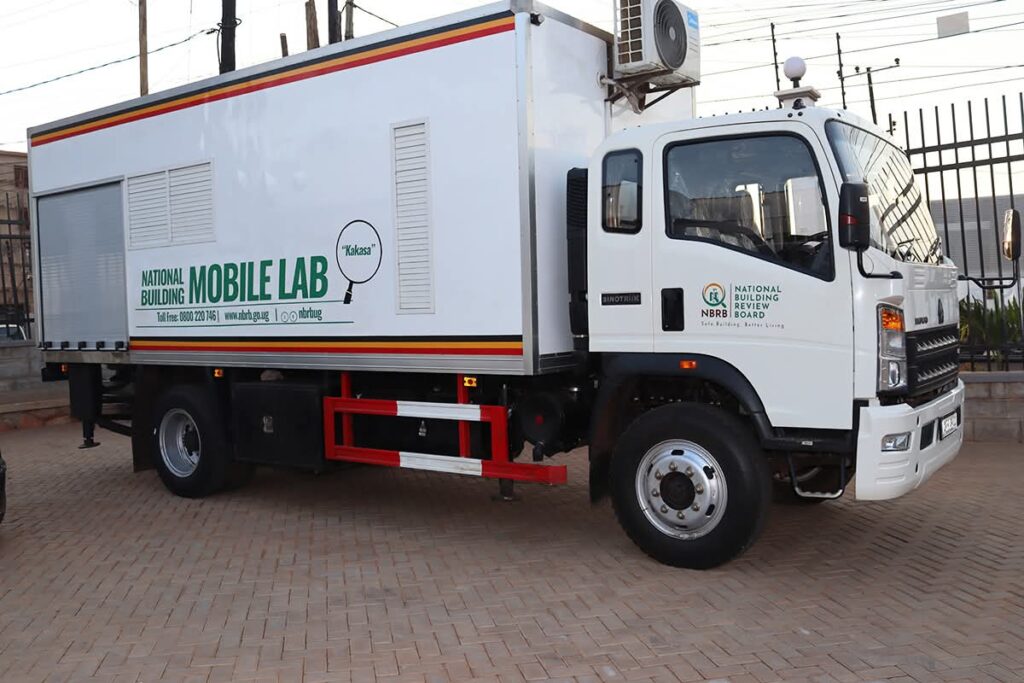
In a groundbreaking stride toward enhancing the safety, quality, and sustainability of Uganda’s built environment, the National Building Review Board (NBRB) has launched the country’s first-ever Mobile Building Materials Testing Laboratory.
This state-of-the-art innovation redefines how the safety and performance of buildings are assessed by seamlessly bridging the long-standing gap between field investigations and laboratory testing.
By taking science directly to construction sites, the NBRB is setting a new benchmark for evidence-based monitoring and regulatory oversight across the building construction sector.
A mobile solution for a dynamic sector
Since Uganda’s construction industry is fast-paced, geographically diverse, and often constrained by limited access to reliable laboratory testing facilities, the Mobile Lab is conceived to address this challenge by bringing the laboratory to the field.
Housed in a high-tech vehicle, the Mobile Laboratory is designed to conduct on-site testing for a wide range of building and environmental parameters.
Equipped for civil engineering materials testing, mechanical and electrical building services assessments, and environmental monitoring of water, air, noise, and wastewater quality, the Lab provides a comprehensive, multidisciplinary approach to evaluating the safety and performance of buildings.
This allows NBRB to conduct reliable and efficient evidence-based testing at the source.
Enhancing building safety and compliance
The Mobile Laboratory plays a key role in supporting building compliance through:
- Conducting independent verification tests on materials and workmanship at construction sites;
- Supporting investigations into building failures and structural defects; and
- Providing evidence-based assessments to inform decisions on building safety and compliance with the Building Control Act.
Through these interventions, the Mobile Laboratory strengthens public confidence in Uganda’s construction industry, transforming compliance from a procedural requirement into a culture of safety, accountability, and quality assurance.
Research, innovation and sustainability
Beyond compliance, the Mobile Lab is redefining how science informs construction practice in Uganda.
By generating reliable, field-based data, the lab provides an invaluable foundation for developing evidence-driven building policies, codes, and standards.
Its testing capability extends to environmental parameters, including emissions, water, air, and noise quality.
This will enable the monitoring of potential pollutants, thereby advancing sustainable and green construction practices.
Moreover, the lab serves as a platform for collaboration, linking academia, professionals, local governments, and sector agencies in a shared pursuit of knowledge and innovation.
Digital transformation and traceability
In keeping with the global shift toward digital transformation, the Lab is powered by the Building Laboratory Information System (BLIS), a fully integrated digital platform designed to streamline every stage of laboratory operation.
Through BLIS, test requisitions, sample registration, and tracking are seamlessly automated using barcodes and GPS-linked metadata, ensuring complete data traceability from the field to the final report.
The system further enables secure data storage, electronic verification, and rapid report generation, thus promoting transparency, accountability, and efficiency.
This digital backbone positions the Mobile Laboratory at the forefront of smart, data-driven laboratory management.
Driving the vision of a sustainable and regulated built environment
The NBRB Mobile Laboratory embodies the Board’s vision of a safe, sustainable, and well-regulated built environment.
By combining science, technology, and regulatory oversight, it strengthens Uganda’s ability to protect life and property, ensure construction quality, and promote environmental stewardship.
The Mobile Laboratory stands as a tangible symbol of innovation and accountability — driving progress toward a resilient and sustainable future for Uganda’s built environment.