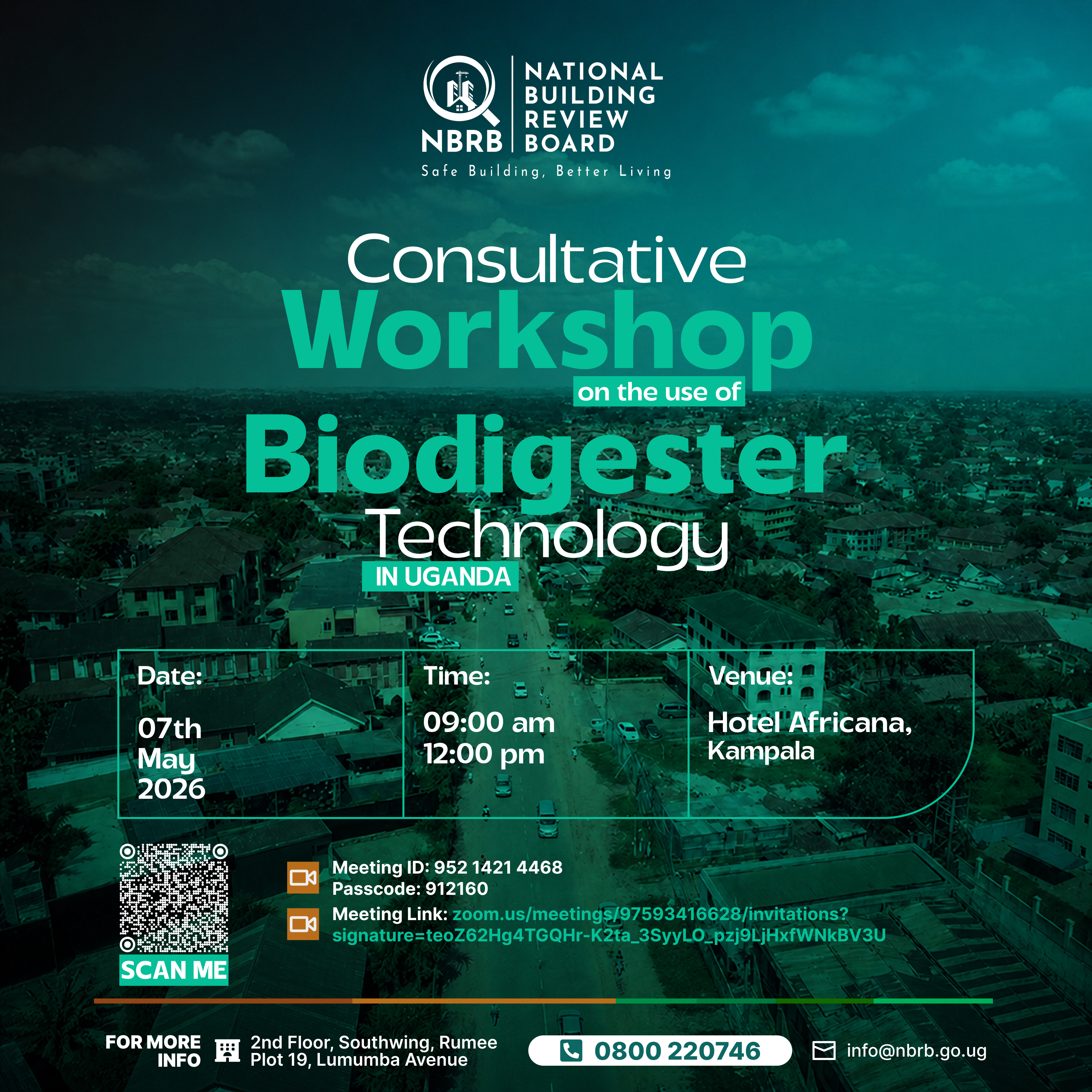
The National Building Review Board (NBRB) will convene a stakeholder consultative workshop to review findings from its study on the use of biodigester technology in Uganda, as part of ongoing efforts to strengthen sanitation standards within the built environment.
The workshop, scheduled for 7 May 2026 at Hotel Africana in Kampala, will bring together key stakeholders, including building professionals, environmental and public health specialists, urban planners, regulators, and implementation partners, to deliberate on the study’s findings and provide technical input toward the development of national guidelines.
Addressing Gaps in Onsite Sanitation Systems
Across Uganda, the majority of households and institutions rely on onsite sanitation systems such as pit latrines and septic tanks, particularly in areas where centralized sewer infrastructure is not available.
While these systems provide basic containment of waste, they often require frequent emptying and can pose environmental and public health risks when not properly managed.
With increasing urbanisation, limited space, and growing demand for improved sanitation solutions, alternative technologies such as biodigester toilet systems have gained traction, especially in urban and peri-urban areas.
Biodigester systems are promoted as longer-lasting sanitation solutions that use anaerobic processes to break down faecal waste, reduce sludge accumulation, minimise odour, and produce effluent for discharge through soak pits.
However, despite their growing popularity, there has been limited independent scientific evidence to validate these claims under real-world conditions.
Generating Evidence for Regulation and Standards
In response to these gaps, NBRB undertook a comprehensive study under its mandate provided by the Building Control (Amendment) Act, 2026, to assess the performance and application of biodigester technology in Uganda.
The study examined biodigester systems, associated soak pits, commercial additives, and design variations under both field and laboratory conditions.
It combined multiple approaches, including field surveys, wastewater analysis, sludge characterisation, soil infiltration testing, and system performance monitoring across selected sites in Kampala, Wakiso, Mukono, and Luwero districts.
Findings from the study provide critical insights into the actual performance, limitations, and appropriate application of biodigester systems, and are expected to inform future regulatory, technical, and policy decisions.
Towards Standardised and Safe Application
NBRB notes that the absence of standardised design, installation, and operational practices has contributed to variations in the performance of biodigester systems. In addition, claims regarding reduced desludging requirements and safe effluent discharge have not been sufficiently verified through independent scientific research.
The upcoming consultative workshop will therefore provide a platform for stakeholders to review the study findings, validate key technical considerations, and contribute to the development of practical and enforceable guidelines.
Strengthening Collaboration in the Built Environment
The Board emphasizes that stakeholder engagement is essential in ensuring that any guidelines developed are technically sound, contextually relevant, and practically applicable across Uganda.
The workshop is expected to generate valuable input that will guide the finalisation of guidelines on biodigester technology, ensuring that its adoption within the built environment is safe, effective, and aligned with national standards.
NBRB has invited stakeholders to actively participate in the consultative process, noting that their input will play a critical role in shaping the regulatory framework for biodigester technology in Uganda.