The Government of Uganda has rolled out reforms in the building sector following the amendment, assent, and commencement of the Building Control (Amendment) Act, 2026, a law that tightens regulations and improves compliance and safety standards across the sector.
The amendments, which took effect on March 19, come at a time when the country continues to grapple with challenges such as illegal developments, non-compliance with building standards, and recurring incidents of building collapse that have led to loss of life and property.
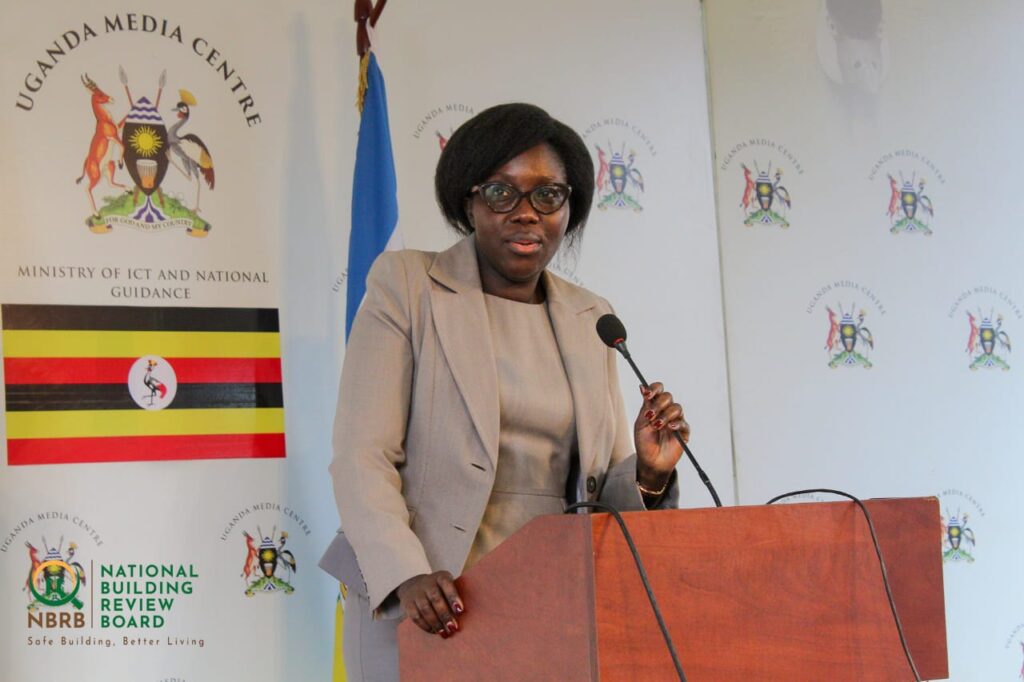
Addressing the media at the Uganda Media Centre, the Executive Secretary of the National Building Review Board (NBRB), Eng. Flavia Bwire noted that the reforms are intended to promote safety, order, and accountability in Uganda’s building sector.
“All developers, contractors, professionals, and the general public are urged to comply with the law and adhere to approved building standards and procedures,” Bwire added.
The key highlights of the amendment include expanding the powers of NBRB and building committees, introducing express and stringent penalties for building-related offences, among others. Specifically:
Membership of the Board
For effective corporate governance, the Act has reduced the membership of the Board from 16 to 9 members, including a representative from the Ministry of Works and Transport, the ministry responsible for gender, the ministry responsible for lands, the ministry responsible for local governments, Attorney General’s chambers and four representatives from the professional bodies of Engineers, Architects, Physical Planners and Surveyors.
Functions of the National Building Review Board (NBRB)
The Act has expanded the functions and powers of the Board under section 8 to include hearing and determining complaints from any person, a Building Control Officer or a Building Committee.
Previously, the powers of NBRB were limited only to complaints about building permit approval processes. However, the same have been expanded to include any complaints in relation to a building or building operation.
https://x.com/UgandaMediaCent/status/2042170246975422810
Powers of the National Building Review Board (NBRB).
NBRB now has the Power to issue stop or evacuation orders in circumstances where a Building Committee has failed to comply with recommendations of the Board and safety is compromised at a building.
It can also issue express penalties for certain offences as may be prescribed by the Minister by regulations, enter onto any land, building or site where a building operation is being carried out to enforce the Act, guide Building Committees on procedural matters, make complaints to the police relating to building matters for investigation and refer complaints concerning professionals to professional bodies as appropriate.
Membership and Powers of Building Committees (BCs)
The Act has revised the membership of the Building Committee from 11 to 5 members and designates a Chairperson and Secretary, which did not exist in the law before.
The act has further expanded enforcement powers of the Committees to include powers to demolish or order evacuation of buildings constructed in contravention of the Act and regulations.
Previously, the Building Committee could only order demolition in writing where deemed necessary however, it did not possess the power to cause the demolition in the case of errant developers most importantly for safety reasons.
https://x.com/nbstv/status/2042185990513537082
Use of unconventional methods, technologies and materials in building operations
Previously the Act provided only for prohibition of unsafe building methods and materials by the Minister of Works and Transport.
This for example gave rise to the prohibition of the Steel Timber Concrete Composite (STC) building method which was deemed unsafe for use after rigorous studies were conducted concerning it.
The Amendment expands the provision not only to prohibit but also to encourage innovation by providing for the approval of use of unconventional methods, materials and technologies in building operations.
Innovators are encouraged to apply, in a process that shall be stipulated in regulations, for their various building related innovations to be studied and recognised through gazetting, for use by the public.
Liability for causing accidents in buildings or on building construction sites
Previously this section was limited to liability for negligence causing death, injury or destruction of property on building construction sites.
The Board has over the years investigated various building related accidents that occur on complete buildings, not necessarily building construction sites.
Therefore, the amendment expands liability for negligence to encompass not only causing accidents on building construction sites but also on/in buildings.
The penalty for negligence under this section has also been increased and made more deterrent from a fine not exceeding two hundred eighty currency points-UGX.5,600,000/=) on conviction) to five hundred currency points (UGX.10,000,000/=) or imprisonment not exceeding 12 years or both.
https://x.com/NBRBug/status/2042167000965747194
Increment in penalties for various offences
The purpose of the increased penalties is to make them more deterrent so as to achieve the purpose of the Act which is to ensure planned, safe, decent structures in harmony with the environment.
The effects of the listed offences are far reaching therefore; non-compliance ought to be aptly penalised;
For example, building without a permit (regardless of the classification of building) the penalty increased from 50 currency points (UGX.1,000,000) or 2 years imprisonment to 2 currency points per square metre of the built-up area or 5 years imprisonment or both.
Building after the expiry of a permit- penalty increased from 25 currency points (UGX. 500,000) or imprisonment for 13 months or both and a further 2 currency points for each day the offence continues after notice is given to two currency points per square meter of the built-up area, after expiry of building permit.
Building using prohibited methods- penalty increased from 48 currency points or 2 years imprisonment or both to 5 currency points per square metre of built-up area using the prohibited method
Eng Bwire revealed that the Board is developing regulations to operationalise the amendment.
“The regulations will guide guide on matters of demolition, procedure for approval of use of unconventional technologies and materials, express penalties for strict liability offences and complaints resolution among others” She added.