The partnership brings national statistical capacity to a survey of 200,000 buildings, giving Uganda its first accurate picture of the safety and condition of the buildings people live and work in.
The National Building Review Board (NBRB) has signed a Memorandum of Understanding with the Uganda Bureau of Statistics (UBOS) to design and deliver Uganda’s first Baseline Survey of Buildings.
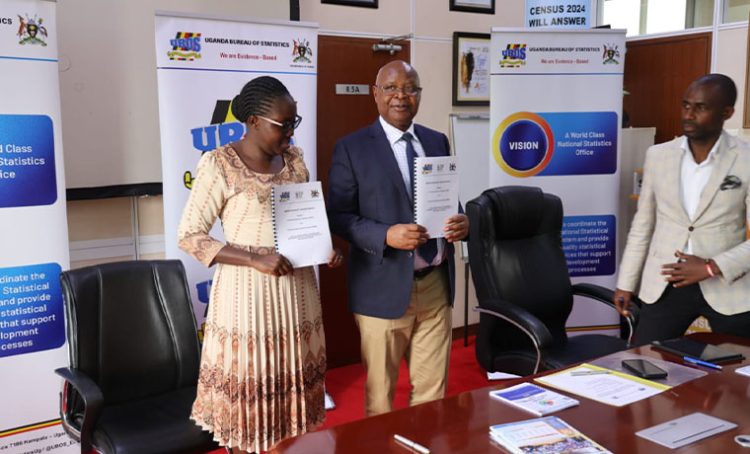
The agreement was signed at Statistics House on Friday. The Executive Director of the Uganda Bureau of Statistics, Dr Chris Mukiza, presided over the ceremony. The Board delegation was led by the Executive Secretary, Eng Flavia Gutto Bwire.
Uganda has over 10 million buildings and no national record of their condition. Building records today sit scattered across local governments, ministries and separate permitting systems, so no authority holds a complete picture. The survey closes the gap.
Field teams will assess 200,000 buildings across 11 cities, 31 municipalities and 135 district local governments, recording building characteristics, structural condition, compliance with building regulations, ownership, occupancy and location.
NBRB will carry out the survey under Sections 8 and 9 of the Building Control Act, Cap. 136, which require the Board to monitor building operations, promote safe and decent structures, oversee District and Urban Building Committees, and report to the Minister on the state of building control in Uganda.
What the partnership delivers
The two institutions will establish a Joint Technical Committee to oversee the survey from methodology through to the release of findings. The committee takes responsibility for questionnaire development, pilot testing, field operations, data processing, validation and dissemination.
The Uganda Bureau of Statistics provides technical leadership in survey design, statistical methodology, quality assurance, data processing, analysis and dissemination. The Board coordinates implementation, mobilises resources, and supplies technical expertise in building inspection, construction standards and regulatory compliance.
Dr Mukiza told the ceremony the collaboration strengthens Uganda’s National Statistical System and shows the value of partnership in producing credible evidence for national planning. He said official statistics remain essential where accurate data guides policy and the allocation of public resources.
“Every building in Uganda holds somebody’s family, somebody’s business or somebody’s classroom. We have regulated the sector without knowing how many buildings stand, what they are built from, or which ones need attention. This survey ends the guesswork. With the Bureau beside us, the numbers will carry the authority national planning demands,” Dr Moris Oleng, Senior Research Officer stated.
Why the survey matters
Uganda’s building sector has grown faster than the systems regulating the sector. Urban growth runs at 5.2 per cent a year, among the highest rates in Sub-Saharan Africa, and urbanisation is expected to pass 30 per cent by 2035. Construction contributes near 12 per cent of national output.
Building collapses, fire outbreaks and non-compliant construction continue across the country.
Findings from the survey will direct inspections towards the buildings carrying the highest risk, benchmark the performance of Building Committees, guide revision of the National Building Code, and support disaster risk reduction in areas exposed to flooding, landslides and seismic activity along the East African Rift System.
The survey supports Uganda Vision 2040, the Fourth National Development Plan, Sustainable Development Goals 9 and 11, the African Union Agenda 2063 and the Sendai Framework for Disaster Risk Reduction.
What happens next
The Joint Technical Committee begins work on the survey methodology and instruments. A pilot will run in one urban and one rural setting before national deployment. Enumerators will use GPS-enabled tablets to record each sampled building.
Communities will be notified before field teams arrive. Officers will carry identity cards. No payment is asked for or accepted, no tax assessment follows a visit, and no demolition order follows a visit.
Findings will be published at the State of the Building Sector Conference in Kampala from 9 to 11 December 2026, where the survey report stands as the flagship publication.