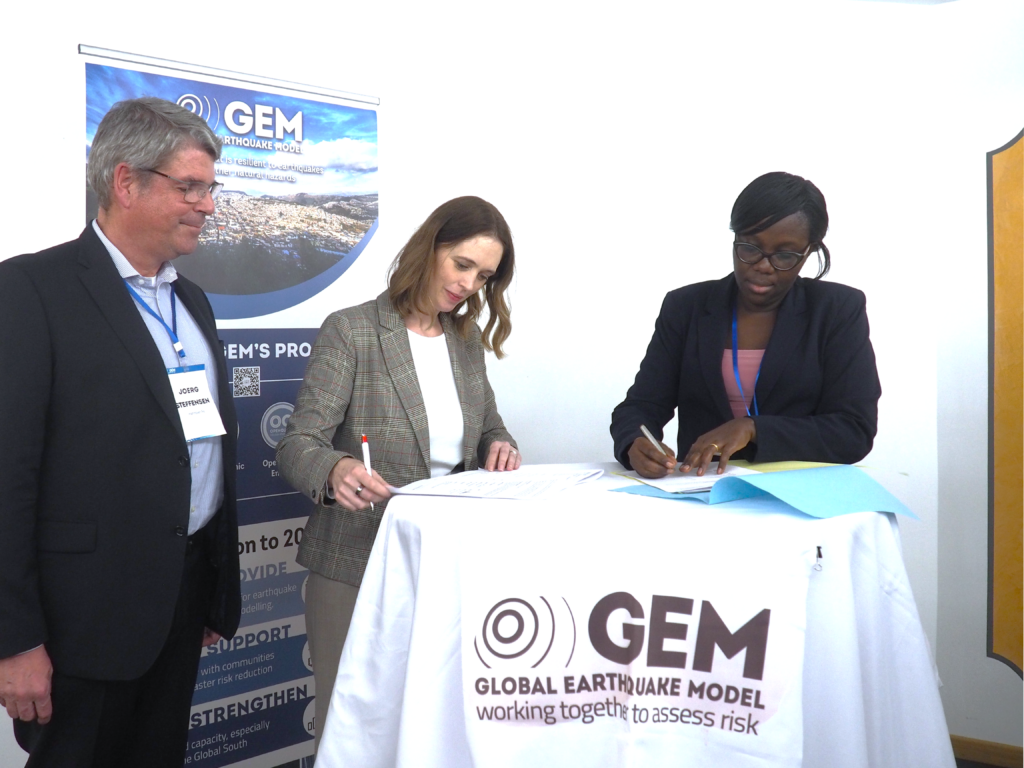
A partnership between the National Building Review Board and the Global Earthquake Model Foundation
The SERENE Project stands for Seismic Evidence for Risk Engineering Norms and Education.
It’s a strategic, public-private partnership between the National Building Review Board (NBRB) and the Global Earthquake Model (GEM) Foundation, a globally recognised authority on seismic hazard and risk modelling.
This multi-year program brings together world-class seismic risk models, technical mentorship, and national policy frameworks to strengthen Uganda’s ability to withstand earthquake-related disasters.
This initiative is all about protecting lives, homes, schools, hospitals, and infrastructure across Uganda by applying world-class science and data to strengthen how we plan, build, and regulate our cities.
Uganda has already witnessed the devastating impact of seismic events:
Uganda’s urban growth, poor enforcement of building codes, and lack of seismic data made a strong case for action.
Recognizing this, His Excellency the President of Uganda, issued multiple directives for earthquake-resistant construction, retrofitting assessments, and code enforcement.
The SERENE Project is Uganda’s official response: a long-term commitment to using science, data, and collaboration to protect citizens, property, and public infrastructure.
Uganda sits between two arms of the East African Rift System, making earthquakes a real and present threat.
As cities grow and more people move into multi-storey buildings, the risks increase, especially when buildings are not up to standard.
The SERENE Project directly responds to Presidential directives demanding earthquake-resilient construction, regular building inspections, and the revision of outdated codes.
By turning these mandates into action, the SERENE Project is building national resilience, not just reacting to disasters.
This partnership is formalized under a 3-year agreement (2025–2028), making Uganda the first African country to be granted full participation in GEM’s strategic governance without financial contribution.
The SERENE Project addresses seismic risk at every level, from scientific modelling to on-the-ground training. Its key goals include:
All of this aligns with Uganda’s Vision 2040, the National Development Plan (NDP IV), National Disaster Risk Reduction Strategy, Uganda Seismic Code modernisation process and the Sustainable Development Goals
The project is earmarked to kick off in 2026, with several work packages included:
These efforts aim to generate Uganda’s first earthquake economic loss map and update the national risk profile.
The SERENE Project is designed for the public good. Here’s how communities will benefit:
Is this project funded by the government?
A: No direct funding is involved. Uganda provides expert time and in-kind support, while GEM supplies tools, data, and technical mentorship.
Will this affect how buildings are approved?
A: Yes. The SERENE Project will strengthen regulation and help revise Uganda’s seismic code to improve building safety.
What regions benefit the most?
A: High-risk seismic areas like Fort Portal, Bundibugyo, Hoima, and Mbarara will benefit directly from improved data and risk mitigation planning.
Who will be trained through this project?
A: Engineers, building inspectors, urban planners, and policy-makers will receive technical training in seismic modelling and enforcement.
Copyright © 2024 , National Building Review Board | All rights reserved.